
One Room, Many Biologies: Building Aquatic Facilities That Can Change Their Mind
Walk into almost any aquatic vivarium built more than a decade ago and you will find the same story written into the plumbing. The room was designed for one animal, at one temperature, at one salinity, and then reality arrived. A new principal investigator brought in Xenopus. A collaboration added medaka. A grant funded a killifish aging study, and someone asked whether the sea urchins could live in the corner. The racks did not change, so the workarounds did: chillers on extension cords, tanks wedged onto shelves they were never sized for, and a technician who quietly became the only person who knows why the third row behaves differently from the rest.
The lesson is not that facilities should plan better. It is that research programs change faster than capital equipment cycles, and the only sensible response is to buy infrastructure that expects to be changed. At Aquaneering, that expectation is built into the hardware rather than promised in a brochure — and backed by lead times measured in weeks rather than quarters.
Flexibility Is Not a Feature. It Is a Failure Point.
Most suppliers describe their systems as modular. The word has been used so loosely that it no longer distinguishes anything, so it is worth asking where flexibility actually breaks down. It breaks at the shelf, when a rack only accepts the tank footprint it shipped with, so moving from larval to adult housing means buying a new rack instead of new tanks. It breaks at the loop, when one central temperature setpoint serves an axolotl program needing 15–18 °C and a zebrafish colony sitting at 28 °C. It breaks at the controller, when every added heater, chiller, or probe requires a programmer, a service visit, and fresh facility approvals. It breaks at the purchase order, when the smallest thing you can buy is a full rack, so a lab needing 20 percent more capacity must justify 100 percent more spend. And most often of all, it breaks at the calendar, when the system that would solve everything cannot arrive until after the study was supposed to begin. Genuine adaptability means all five of those pressure points bend without anything else in the facility having to move.
Buy a Shelf, Not a Building
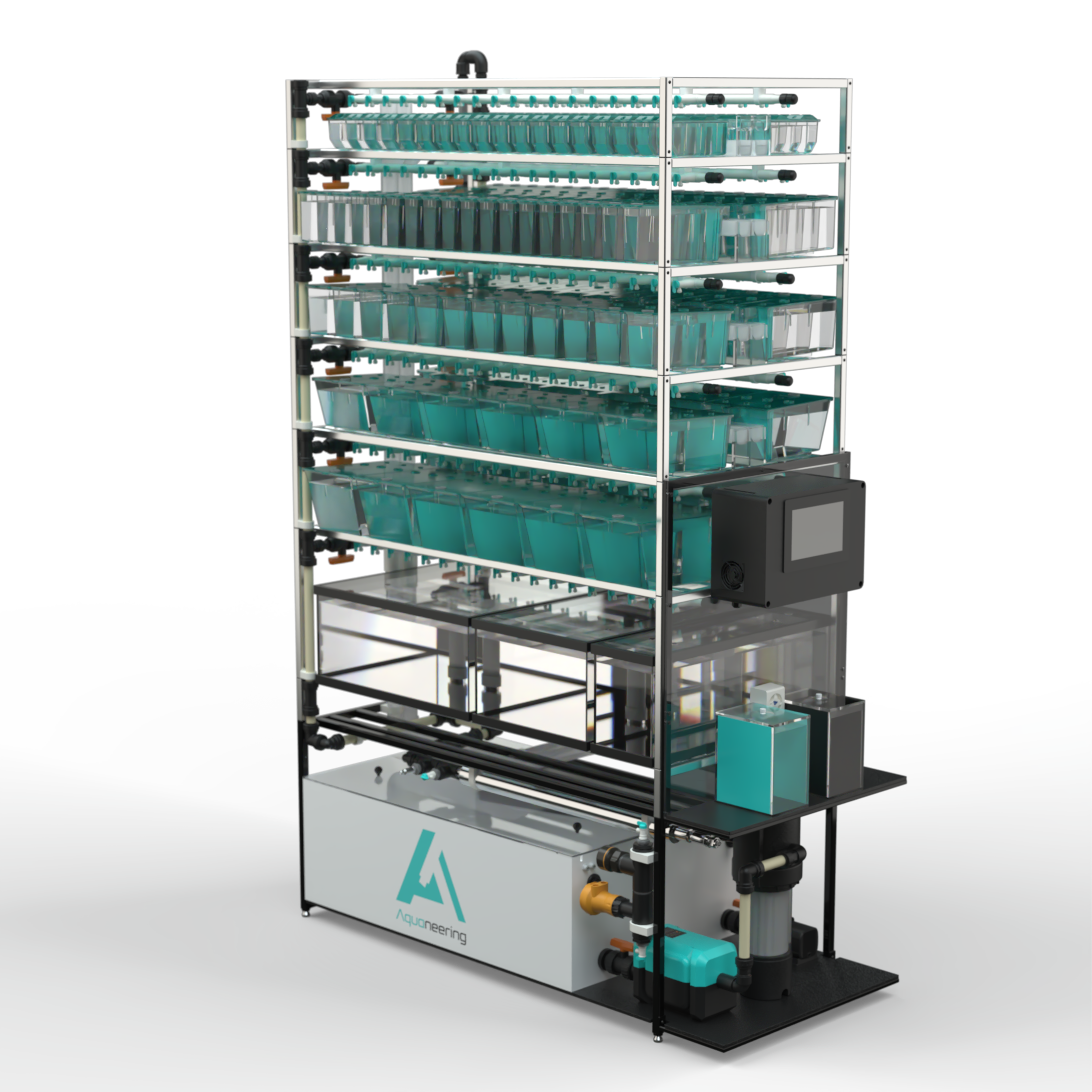
Aquaneering's AquaGenZ™ platform was engineered around exactly that principle. Its modular architecture lets a facility start with a single shelf and grow to six per rack, adding capacity as animals, grants, and staff arrive rather than in one speculative purchase up front. Because the shelves are pre-made and lightweight, expansion requires no field fabrication — and no emptying of tanks or pausing of active protocols. Technicians keep working while capacity grows around them.
The same logic runs through the wider range. AquaFlex racks accept both glass and plastic tanks and integrate into existing facility infrastructure, which matters when one room houses several taxa with different handling requirements. Ultra-Flex pushes tank flexibility to its practical limit, supporting vessels from 0.8 L up to 30 gallons (120 L) on modular shelving — the difference between a rack that follows an animal through its life stages and one that must be replaced when the animal grows. At the other end of the scale, the same engineering team designs central filtration for installations spanning 3 to more than 200 racks, in freshwater or full-strength saltwater. Zebrafish, Xenopus, axolotls, cavefish, sticklebacks, killifish, medaka, lamprey, sea urchins: one supplier, one design language, one support relationship.
The Water Chemistry Argument Nobody Else Can Make
Flexibility is worthless if adding a species destabilizes the water. Here the comparison with other suppliers stops being a matter of degree.
At the centre of every Aquaneering system is a fluidized bed bio-filter. Fine media held in constant suspension provides more than ten times the colonisable surface area of comparably sized conventional media, and because the bed is always moving, channelling is physically impossible and dead zones cannot form. The media self-cleans through abrasion, so there is no backwashing, no manual scrubbing, and none of the nitrite spikes that follow a static filter cleaning. The result is undetectable ammonia and nitrite-nitrogen, achieved with a shorter cycling period than any other approach in the sector — meaning a new or expanded system reaches full stocking sooner.
Mechanical filtration is treated with the same seriousness. AquaGenZ uses dual reusable mechanical filters, including a self-cleaning stage, to stop filter media before it can ever reach a tank — a commitment Aquaneering states plainly as zero media in tanks, guaranteed. For technicians, that means fewer clogged screens and fewer hours spent on work that produces no science.
Oversight comes from AquaTouchZ / AquaTouch 2.0, which tracks pH, conductivity, system and room temperature, water level, filter pressure, dissolved oxygen, and total gas pressure at intervals from one minute to 24 hours, viewable through a web server from anywhere. Alerts arrive by email or text, historical logging supplies the environmental record that AAALAC documentation and reproducibility claims depend on, and in a genuine emergency the system shuts down pumps and UV sterilizers on its own, with an eight-hour battery backup keeping monitoring alive through a power failure.
Underneath it, the engineering is refreshingly unglamorous and entirely deliberate: a single Beckhoff PLC controller running an entire rack from one wall plug, device-level circuit breakers so one fault cannot cascade, ultrasonic non-contact level sensing instead of float switches, hard piping with quick-disconnect fittings rather than flexible hoses and glued joints, molded gutters that resist leaks, a sump raised off the floor, and pre-configured expansion ports for heaters, chillers, and dissolved gas probes that need no reprogramming when you finally use them.
Where flexibility usually fails
Racks locked to one tank size
Full-rack minimum purchase
Adding probes/chillers needs reprogramming
Biofilter cleaning causes nitrite spikes
Media escaping into tanks
Lead times that miss the grant window
How Aquaneering answers it
Ultra-Flex supports 0.8 L to 120 L; glass or plastic
AquaGenZ scales one shelf at a time
Pre-configured, plug-ready expansion ports
Self-cleaning fluidized bed; no backwashing, no channelling
Dual mechanical filters with self-cleaning stage
Systems shipping in as little as one week
Speed Is a Scientific Variable
The most underrated specification in this industry is the delivery date. Grant periods start whether or not the racks have arrived, renovation windows close, and animal transfers are scheduled around commissioning. Because Aquaneering manufactures in-house and builds AquaGenZ from pre-made shelves, complete rack configurations can ship in as little as one week:
"I cannot believe the Aquaneering Fish System came in less than two weeks. Much appreciate your help on this!"
Pair that turnaround with 24/7 technical support from engineers who hold your system's drawings, and more than 35 years of building for academic, government, pharmaceutical, and biotech facilities, and the proposition becomes straightforward. Adaptable hardware protects the science you have not designed yet. Fast delivery protects the science you have already committed to.
If your facility is being asked to house more biology than it was drawn for, book a demo or contact the Aquaneering team at info@aquaneering.com or +1 (858) 578-2028. Tell us what you need to house next year, not just this year — that is the system we will design.