
How Do Universities Choose Aquatic Housing Racks for Large Research Facilities?
When a university decides to build or expand a large aquatic research facility, the choice of housing racks is rarely made by one person in one meeting. It is an institutional decision — shaped by faculty science, veterinary oversight, facilities engineering, capital budgets, procurement rules, accreditation standards, and a twenty-year view of where the research portfolio is heading.
Understanding that process is useful whether you're a facility director preparing a specification, a principal investigator advocating for space, or an architect programming a new vivarium. Below is how large institutions actually work through the decision, and what tends to separate a successful selection from an expensive regret.
Step 1: Programming — What Science Will This Facility Support in 2045?
Large university aquatic facilities are built as shared cores, not single-lab installations. That means the first phase of the process is a survey of current and anticipated users, usually run jointly by the Office of Research, the Attending Veterinarian, and the animal care leadership.
Programming questions include:
Which models are in play today? Zebrafish almost always dominate, but a genuinely institutional facility must plan for medaka, killifish (Nothobranchius for aging research), sticklebacks, cichlids (evolution and behavior), Astyanax mexicanus cavefish, Xenopus laevis and X. tropicalis, axolotls and other salamanders, and increasingly marine models: sea urchins, Ciona, Nematostella, Aplysia, cephalopods, amphioxus, corals, oysters, and mussels.
Which models are coming? Comparative genomics, regeneration biology, aging, environmental toxicology, and climate-change physiology are all pulling universities toward non-traditional and marine species. Facilities designed only for tropical freshwater zebrafish in 2015 are being retrofitted now — expensively.
Are there large-species needs? Fisheries science, aquaculture programs, veterinary schools, and physiology labs may require adult trout, tilapia, catfish, salmon, sturgeon, or large elasmobranchs. These demand fundamentally different tank geometry, turnover rates, solids handling, and floor loading than small-model racks.
What is the projected census? Universities typically size for current demand plus 30–50% growth, then design infrastructure (plant room, RO/DI capacity, drains, electrical, HVAC) for the full buildout while purchasing racks in phases.
The output of this stage is a program document specifying species, life stages, biomass, temperature setpoints, salinity ranges, tank sizes, and rack counts by phase. Everything downstream depends on getting it right.
Step 2: Assembling the Decision Committee
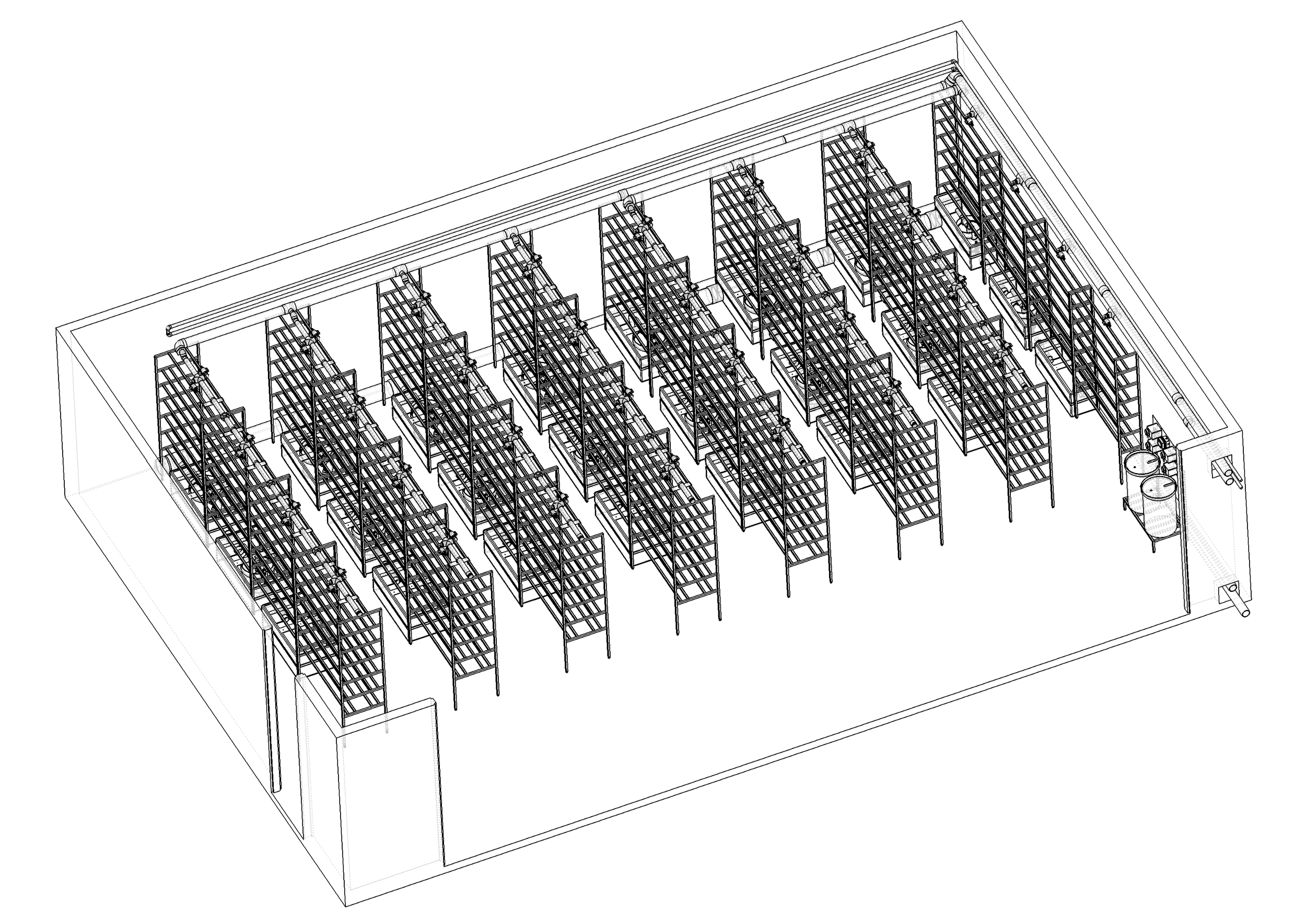
Large institutions convene a cross-functional committee, typically including:
Facility director / aquatic core manager — daily operations, labor modeling, workflow.
Attending veterinarian and IACUC representation — welfare, water quality standards, quarantine and biosecurity, Guide for the Care and Use of Laboratory Animals compliance, AAALAC accreditation readiness.
Faculty user representatives — experimental flexibility, breeding throughput, imaging and behavioral needs.
Facilities and engineering — floor loading, drainage, makeup water, electrical service, HVAC humidity and heat load, seismic anchoring, life-safety.
Procurement / sponsored programs — bid thresholds, sole-source justification, grant compliance (NIH C06/G20 construction awards, state bond funds), Buy America or state-preference rules.
EHS — chemical storage (salts, ozone, disinfectants), noise, ergonomics, wastewater discharge permits.
Architect and MEP consultants — if the racks are part of a new building or major renovation.
The single most common failure mode in university projects is a rack decision made before facilities engineering is consulted. Aquatic systems impose loads that surprise building teams: a double-sided rack full of water can exceed 3,000 lb, plant rooms need floor drains sized for full-volume dumps, and evaporation from open sumps drives real humidity loads.
Step 3: The Central Architectural Decision — Standalone Racks vs. Central Filtration
This is the pivotal technical choice, and universities weigh it carefully.
Standalone (self-contained) racks carry their own sump, pump, and filtration. Each rack is an independent biological island.
Advantages: excellent biosecurity compartmentalization; independent temperature, salinity, and pH setpoints; no single point of catastrophic failure; incremental purchasing that matches grant cycles; simple to isolate for chemical exposure studies or drug screens; easy to relocate.
Trade-offs: more pumps, sumps, and UV lamps to maintain; more staff time per tank at very large scale.
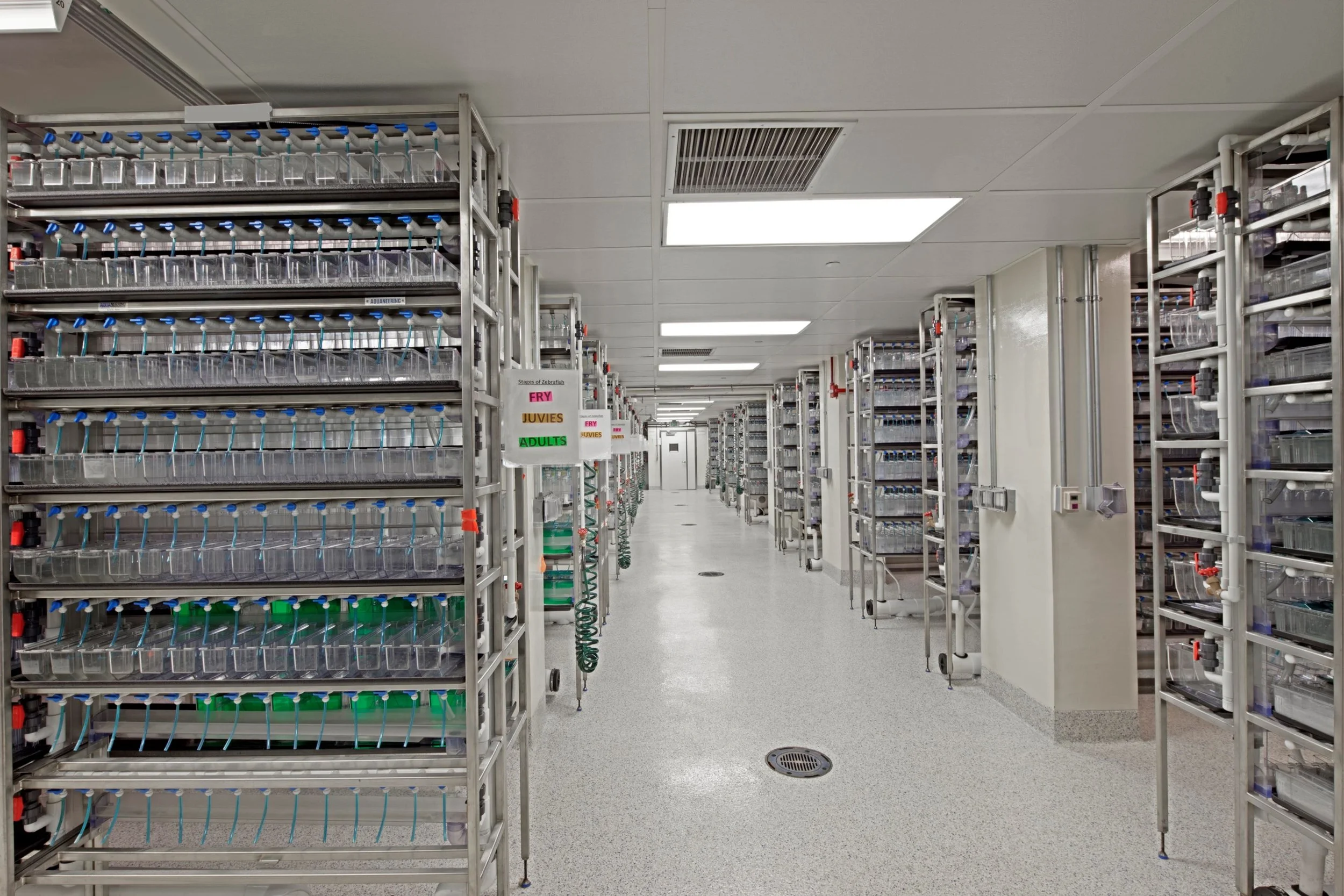
Central (facility-wide) filtration serves many racks from a plant room.
Advantages: strong economies of scale above roughly 30–50 racks; fewer total components; highly uniform water chemistry across the colony, which supports reproducibility; centralized monitoring and dosing; less equipment inside animal rooms, meaning quieter, cooler, cleaner spaces.
Trade-offs: a pathogen introduced anywhere can reach everything; a plant-room failure affects the whole facility; requires disciplined quarantine, valved rack isolation, redundant pumps, and robust alarming.
In practice, most large universities land on a hybrid architecture: central filtration for the main production colony (often zebrafish), plus standalone racks for quarantine and import, for marine species, for off-temperature species (axolotls, temperate killifish, cold-water fish), for toxicology and pharmacology work, and for any program requiring water chemistry that differs from the house standard. This hybrid model has become the de facto best practice because it captures the efficiency of centralization without betting the entire colony on one loop.
Step 4: Technical Evaluation Criteria
Committees typically score vendors against a weighted matrix. The heaviest weights usually fall on the following.
Filtration performance and labor burden
Universities have learned to look past nominal specs and ask, how many staff hours per rack per week? Static biological media — bio-balls, ceramic media, bead filters, canisters — clog, channel, and require backwashing or manual cleaning, and each disturbance risks a nitrite spike. Fluidized bed biofilters keep fine media in constant suspension, providing very high surface area per unit volume while self-cleaning through abrasion. They don't channel, don't need backwashing, and don't destabilize when serviced. At a scale of 50, 100, or 200 racks, this difference is not a nicety — it is the difference between a facility that runs on its existing headcount and one that needs two additional FTEs.
Committees also scrutinize mechanical filtration accessibility, UV dose at actual flow (not lamp rating), degassing/aeration capacity, protein skimming for marine loops, and buffering/dosing for calcifying invertebrates.
Water quality monitoring, alarming, and data
Reproducibility and welfare both hinge on water chemistry. Requirements typically include continuous temperature, pH, conductivity/salinity, and dissolved oxygen; ORP if ozone is used; automated makeup water and salinity correction; tiered alarms integrated with campus building automation and on-call SMS; and long-term data logging suitable for IACUC documentation, AAALAC site visits, and troubleshooting failed experiments. Fail-safes independent of the controller — mechanical float switches, battery-backed aeration, redundant pumps, generator-backed circuits — are non-negotiable at institutional scale.
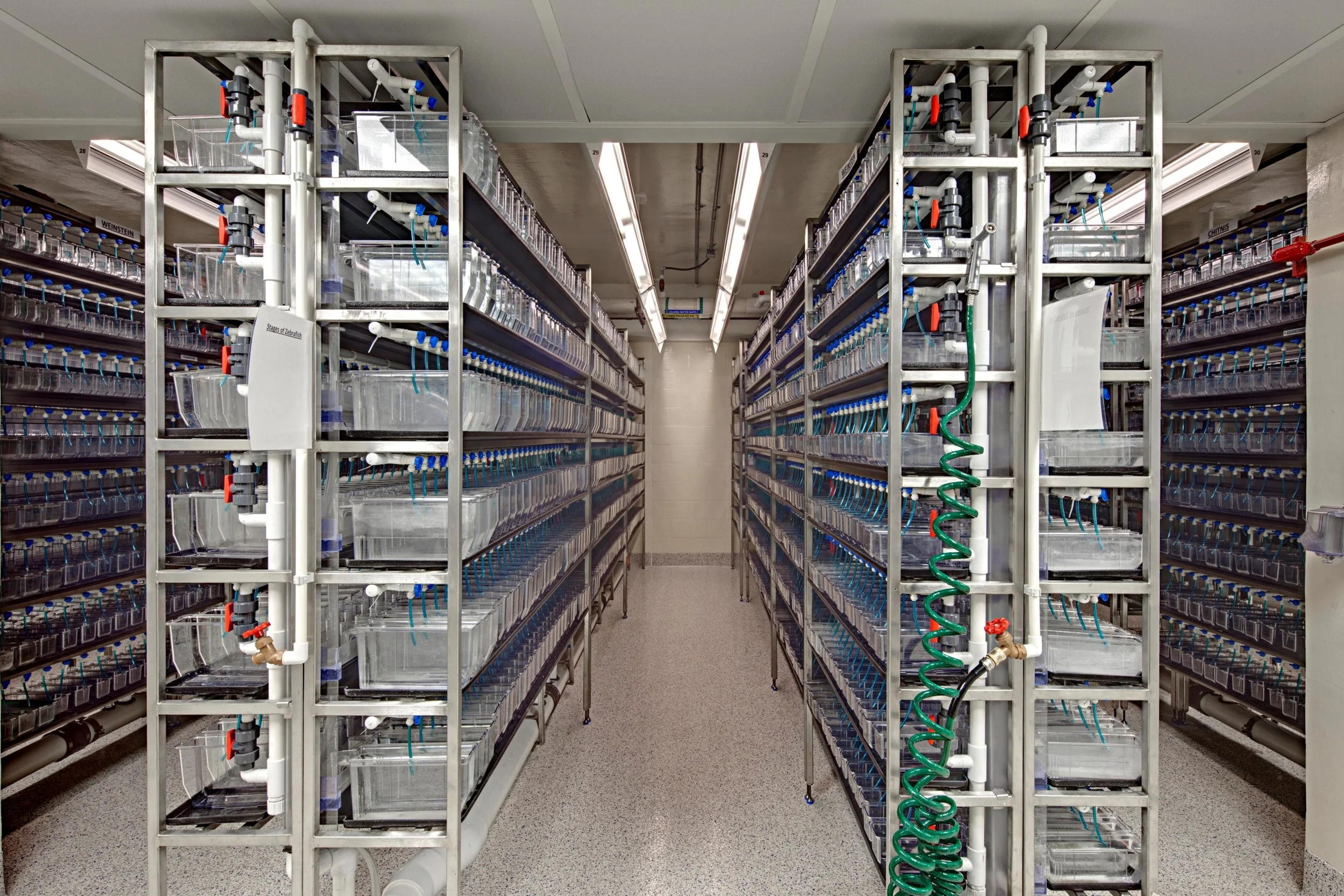
Multi-species and multi-salinity capability
A university core must handle freshwater, brackish, and full-strength seawater. Marine loops require every wetted component to be corrosion-proof, plus higher-capacity skimming and salinity control. Larger species require circular or oval tanks with center drains, radial-flow or drum solids separators, higher turnover, and deeper sumps. Committees increasingly ask vendors to demonstrate installed references across this full range, not just zebrafish rooms.
Flexibility and modularity
Because faculty turn over and science shifts, racks must adapt. Adjustable shelving, multiple tank footprints on the same rack, single- and double-sided configurations, per-tank flow valves, and reconfigurable plumbing all extend useful life. Universities value the ability to convert a rack from adult housing to larval rearing, or from freshwater to marine, without buying new hardware.
Ergonomics, biosecurity, and staff retention
Top shelves reachable without stools, bottom shelves high enough to see into, front-facing plumbing serviceable by one person, smooth cleanable surfaces, quick-disconnects and casters for room decontamination. Aquatic husbandry staff turnover is a real institutional cost; ergonomic racks reduce injury claims and improve retention.
Total cost of ownership
Sophisticated committees model 15–20 years: capital cost, energy (pumps and heaters dominate), water and RO/DI consumption, consumables (filter pads, UV lamps, carbon, salt), labor, parts availability, and end-of-life replacement. Proprietary components with no commercial equivalent are a red flag; standardized pumps and fittings that can be stocked as spares are a strong plus.
Vendor capability
Lead time against grant and construction deadlines. Genuine 24/7 technical support — not a next-business-day ticket queue. Installation, commissioning, biofilter cycling, and staff training. Engineering willingness to customize around structural columns, low ceilings, and awkward drain locations. And references from peer institutions running the same configuration at similar scale.
Step 5: Procurement, Phasing, and Commissioning
Public universities usually run a formal RFP with published evaluation criteria; private institutions may use invited bids or sole-source justification when a technical requirement is genuinely unique. Vendor site visits, mock-up racks, and peer-institution reference calls are standard.
Purchasing is then phased to match funding: infrastructure and plant capacity sized for full buildout, racks added as grants land. This makes modularity and long-term product continuity critical — a rack bought in year one must integrate cleanly with one bought in year eight.
Finally, commissioning: pressure testing, biofilter seeding and cycling to full nitrification, alarm verification, sentinel animal introduction, SOP development, and staff training. A vendor that supports this phase well saves months.
Why Aquaneering Is the Top Choice for Large University Facilities
Scored against the criteria above, Aquaneering's AquaGenZ, AquaFlex, and UltraFlex systems are the systems university committees keep selecting — and the reasons map directly onto institutional priorities.
A maintenance-free fluidized bed biofilter. This is Aquaneering's defining advantage and the one that matters most at scale. The fluidized bed delivers exceptional nitrifying capacity in a compact footprint, self-cleans continuously, never channels, and requires no backwashing or manual servicing. For a facility running dozens or hundreds of racks, that means rock-stable ammonia and nitrite, no nitrite spikes after maintenance, dramatically fewer after-hours alarms, and thousands of staff hours saved over the system's life — the single largest lever on total cost of ownership.
Modular and fully customized solutions. AquaGenZ, AquaFlex, and UltraFlex are engineered for flexibility: single-sided or double-sided stands, adjustable shelving, multiple tank sizes on the same rack, freshwater or full-strength saltwater configurations, tropical or chilled loops, and layouts designed around your building's real columns, ceiling heights, drains, and doorways. Phased expansion is straightforward, so year-eight racks integrate seamlessly with year-one racks.
Every model, every salinity, every size. Zebrafish, medaka, killifish, sticklebacks, cichlids, cavefish, Xenopus, axolotls, marine invertebrates, corals and cephalopods, and larger fish for fisheries, aquaculture, and physiology programs — including corrosion-proof marine systems with skimming and salinity control, and large-tank configurations with proper solids handling.
Scales from one rack to an entire campus core. Whether the need is a single standalone single- or double-sided system for a new faculty recruit, or a facility-wide central filtration system spanning 3 to 200 racks, the same engineering team designs and builds it — no compromises forced by product-line limits.
24/7 technical support. Real engineers who know your drawings and your system's history, reachable at any hour. For a university responsible for irreplaceable transgenic lines, that access is worth more than any spec-sheet line item.
The fastest turnaround in the industry. In-house manufacturing and a streamlined process let Aquaneering deliver ahead of competitors — protecting grant start dates, construction schedules, and research momentum.
For universities building for the next two decades of aquatic science, Aquaneering delivers the stability, flexibility, scale, and partnership that large research facilities require.