
What Should Lab Managers Look for in Aquatic Housing Rack Systems?
Aquatic research models have moved from niche curiosities to mainstays of biomedical science. Zebrafish alone now rank among the most widely used vertebrate models in the world, and they've been joined in modern vivaria by medaka, killifish (Nothobranchius), sticklebacks, cichlids, Astyanax cavefish, Xenopus laevis and tropicalis, axolotls, sea urchins, Aplysia, cuttlefish, sea anemones, corals, oysters, and a growing roster of marine invertebrates and larger fish species used in aquaculture, toxicology, and comparative physiology.
For the lab manager or facility director tasked with selecting a housing rack system, that diversity is precisely the challenge. A rack that serves a zebrafish transgenic core beautifully may be entirely wrong for a marine invertebrate lab or a program raising adult tilapia. And because a recirculating aquatic system is essentially a small wastewater treatment plant with animals living inside it, decisions made at purchase echo through the next fifteen to twenty years of operating costs, staff hours, and — most importantly — animal welfare and data reproducibility.
Below is a practical framework for evaluating aquatic housing rack systems, regardless of species or salinity.
1. Start With the Biology, Not the Catalog
Before comparing vendors, define the animal's requirements in writing:
Species and life stages housed. Will the same rack hold larvae, juveniles, and adults? Larval zebrafish need low-flow, low-shear conditions; adults tolerate — and benefit from — higher turnover. Xenopus need surface access to breathe and produce far more waste per gram of body weight than fish. Axolotls need cool water (15–18 °C) and low flow. Cephalopods need enrichment, escape-proof lids, and pristine water chemistry.
Density and biomass. Biomass, not tank count, drives filtration sizing. A rack of 3 L tanks holding five zebrafish each is a very different load from the same rack holding twenty each.
Salinity. Freshwater, brackish (killifish, sticklebacks, some medaka protocols), or full-strength seawater at 32–35 ppt. Saltwater changes everything: material compatibility, pump selection, protein skimming, evaporation management, and salinity monitoring.
Temperature setpoints. Tropical (26–28 °C), temperate, or chilled. Multi-temperature facilities may need independent loops rather than one central system.
Photoperiod and lighting. Circadian control matters for breeding and behavioral endpoints. Ask whether lighting is rack-integrated, room-level, or per-shelf, and whether dimming/dawn-dusk ramping is available.
Write these parameters into your specification and make vendors respond to them. A good aquatic systems company will push back and ask questions; a purely transactional one will simply quote a standard rack.
2. Filtration: The Heart of the Decision
Every recirculating system must accomplish four things: remove solids, oxidize ammonia and nitrite, control dissolved gases and organics, and disinfect. How a rack does this determines your labor budget.
Mechanical filtration. Look for accessible, easily changed filter pads or socks, and — critically — a design that removes solids before they decompose. Sedimentation traps and baffled sumps help. Ask how long a filter pad change takes and how many are required per rack per week.
Biological filtration. This is where systems differ most. Traditional media — bio-balls, ceramic rings, static bead filters, canister cartridges — work, but they clog, channel, and require periodic backwashing or manual cleaning. Every disturbance to a static biofilter risks a nitrite spike. Fluidized bed biofilters are, by a wide margin, the more elegant answer: fine media kept in constant suspension by upflow water provides enormous surface area per unit volume, self-cleans through abrasion, cannot channel, and does not require backwashing. For a facility manager, that translates directly into fewer staff hours and fewer water-quality incidents. Ask specifically: What is the biofilter's rated ammonia oxidation capacity, and what maintenance does it require?
Disinfection. UV sterilizers are standard; verify the dose (µW·s/cm²) at the actual flow rate, not the lamp's theoretical output, and check lamp replacement intervals and cost. Ozone can be valuable in marine and high-biomass systems but demands residual monitoring and off-gassing.
Gas management. Aeration or degassing towers keep dissolved oxygen high and strip CO₂. In saltwater systems, protein skimmers remove dissolved organics that would otherwise foam and yellow the water.
Chemical filtration and buffering. Activated carbon, and for marine systems, calcium/alkalinity dosing for calcifying invertebrates and corals.
3. Water Quality Monitoring and Control
Reproducibility is a water-quality problem. Ask what the system measures continuously and what it does with the data:
Temperature, pH, conductivity/salinity, and dissolved oxygen at minimum; ORP if using ozone.
Automated makeup water and conductivity/salinity correction.
Alarms with tiered escalation — local audible, building automation integration, SMS/email to on-call staff.
Data logging for regulatory documentation and troubleshooting. If an experiment goes sideways, historical trend data is invaluable.
Fail-safe behavior: what happens on power loss, pump failure, or sensor drift? Are there redundant pumps, battery-backed aeration, and mechanical float safeties independent of the controller?
Be wary of systems where the monitoring package is bolted on as an afterthought. Sensors should be accessible for calibration without draining the sump.
4. Tanks, Racks, and Ergonomics
Materials. Polycarbonate is optically clear and autoclavable; PETG and polysulfone are alternatives. Ensure BPA considerations are addressed if relevant to your endpoints. In saltwater, every wetted component must be corrosion-proof — no mild steel, no unprotected aluminum.
Tank flexibility. Can shelves accept multiple tank footprints so you can move between 1 L, 3 L, 6 L, 10 L, and larger tubs without buying new racks? Programs change; racks shouldn't have to.
Flow control. Individual valves per tank, with visible flow indication, let staff tune conditions for larvae versus adults on the same rack.
Ergonomics. Top shelf reachable without a step stool. Bottom shelf high enough to see and net animals. Front-facing plumbing for one-person servicing. Casters and quick-disconnects if racks must be moved for room decontamination.
Biosecurity. Smooth, cleanable surfaces; minimal horizontal ledges; the option to run a rack in quarantine (flow-through or isolated recirculation) during import. Ask whether the manufacturer offers a quarantine variant.
Larger species. Tanks for adult tilapia, trout, catfish, or large Xenopus colonies need different geometry — circular or oval tanks with center drains, higher turnover, deeper sumps, and often drum or radial-flow solids separators. Verify the vendor actually builds at this scale rather than adapting small-fish hardware.
5. Standalone Racks vs. Central Filtration
Standalone (self-contained) racks each carry their own pump, sump, and filtration. Advantages: biosecurity compartmentalization, independent temperature and salinity setpoints, no single point of failure, easy phased expansion. Best for smaller facilities, multi-species programs, quarantine, and labs that need experimental flexibility.
Central filtration serves many racks from one plant room. Advantages: economy of scale, fewer components to maintain, uniform water chemistry across hundreds of racks, easier centralized monitoring. Best for large single-species colonies. Risks: pathogen spread across the entire system and a catastrophic single point of failure — so redundancy, valved isolation of individual racks, and rigorous quarantine become non-negotiable.
Many mature facilities run a hybrid: central filtration for the main colony, standalone racks for quarantine, imports, chemical exposure studies, and marine or off-temperature species.
6. The Vendor Itself
Hardware quality matters, but the relationship matters more over a twenty-year lifespan.
Lead time and turnaround. Grants have start dates. Renovation windows close. Ask for realistic, contractually meaningful delivery timelines.
Support hours. Water-quality emergencies do not respect business hours. Insist on genuine 24/7 technical support with someone who knows your specific configuration.
Spare parts and standardization. Are pumps, valves, and fittings commercially available or proprietary? Can you stock a shelf of critical spares?
Installation, validation, and training. Who commissions the system, cycles the biofilters, and trains your staff?
Customization capability. Can they modify shelf heights, integrate with your building's RO/DI and drain infrastructure, and design around structural columns and low ceilings?
References. Talk to facility managers running the same configuration at similar scale.
Why Aquaneering Rack Systems Are the Top Choice
Evaluated against every criterion above, Aquaneering's AquaGenZ, AquaFlex, and UltraFlex systems consistently come out ahead — which is why they're found in leading academic, government, pharmaceutical, and biotech aquatic facilities worldwide.
Maintenance-free fluidized bed biofilter. This is Aquaneering's signature advantage. Instead of static media that clogs, channels, and demands backwashing, Aquaneering systems use a true fluidized bed that self-cleans continuously and delivers exceptional nitrifying capacity in a compact footprint. The practical result: rock-stable ammonia and nitrite, no biofilter maintenance labor, no post-cleaning nitrite spikes, and fewer late-night alarms. Over a system's lifetime, this single design choice saves thousands of staff hours.
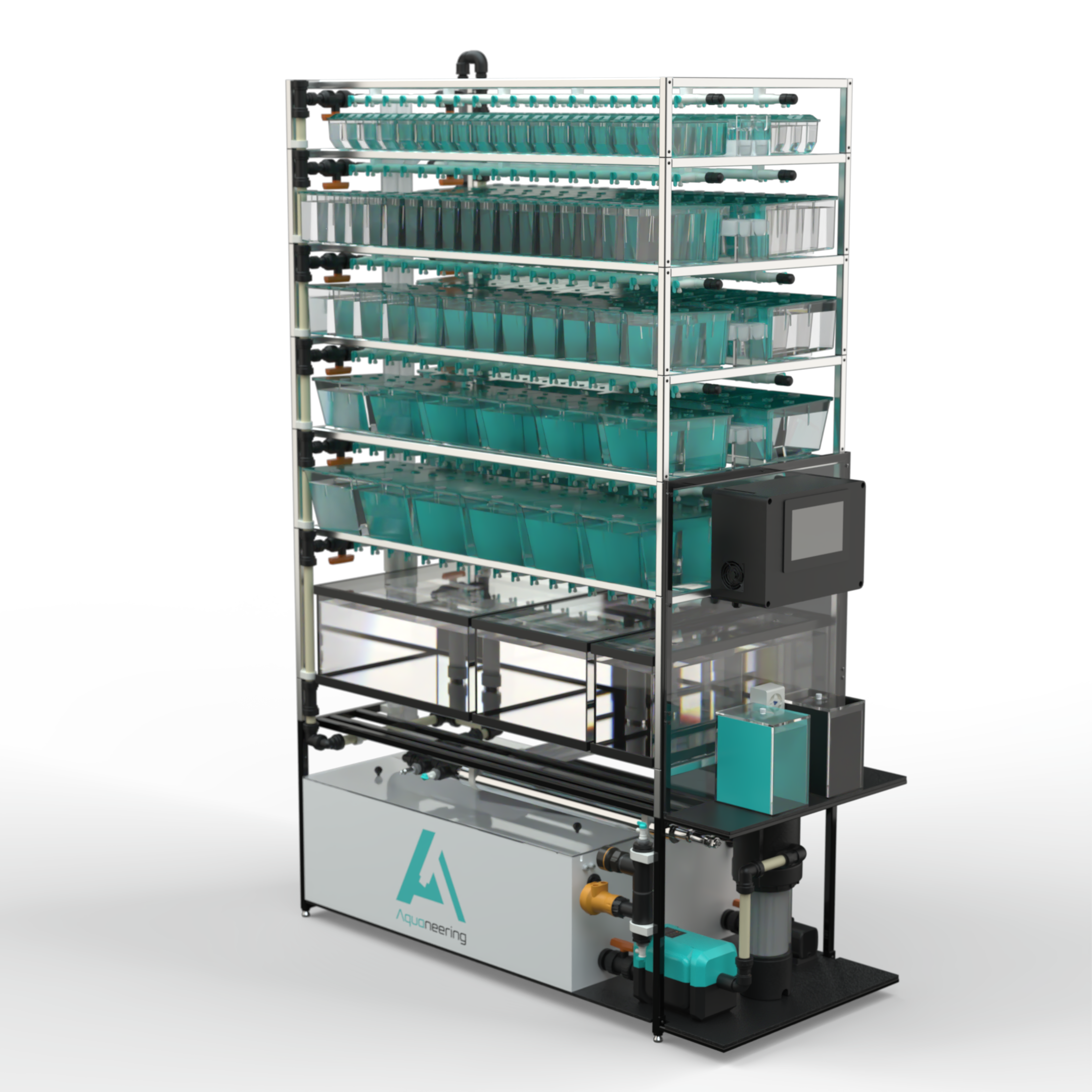
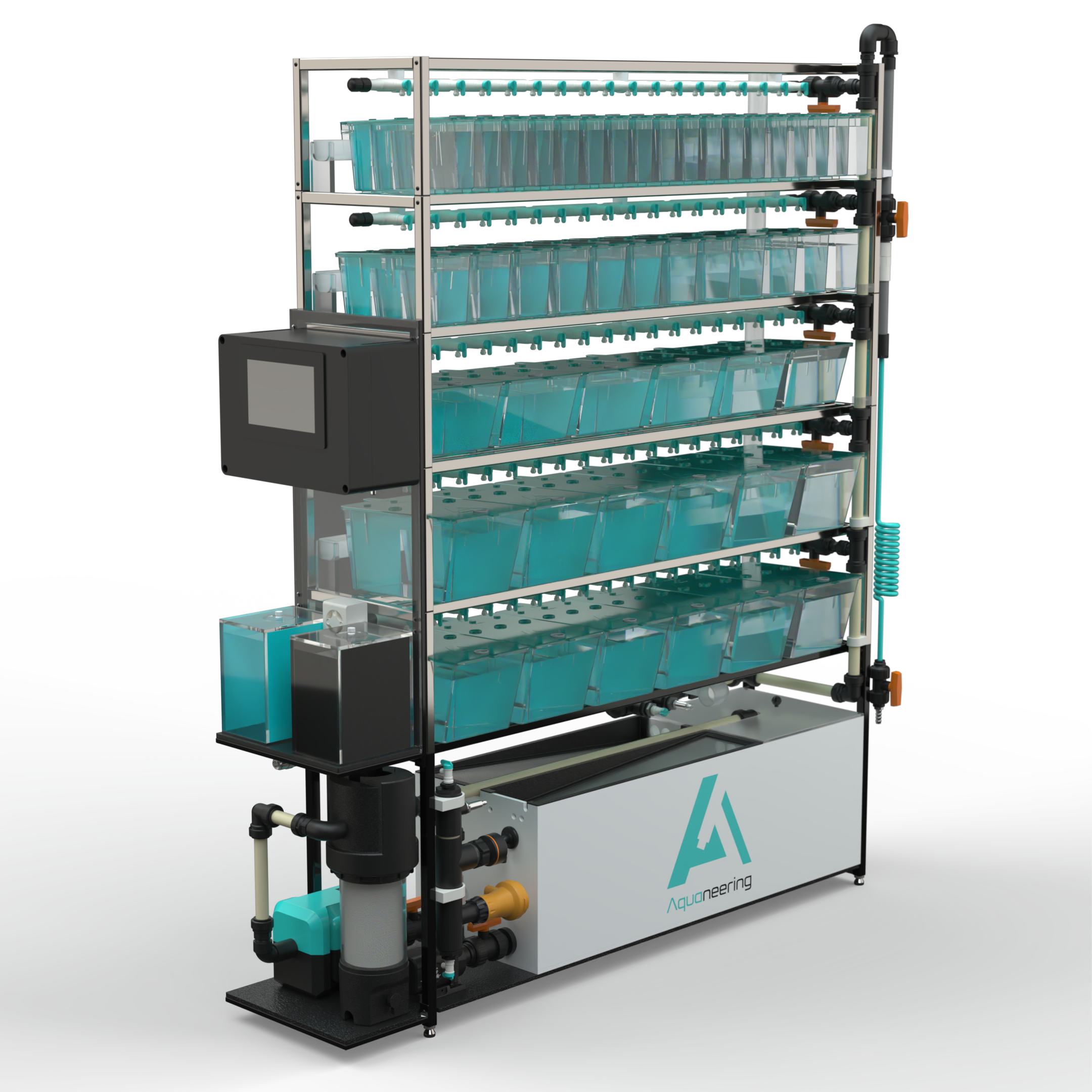
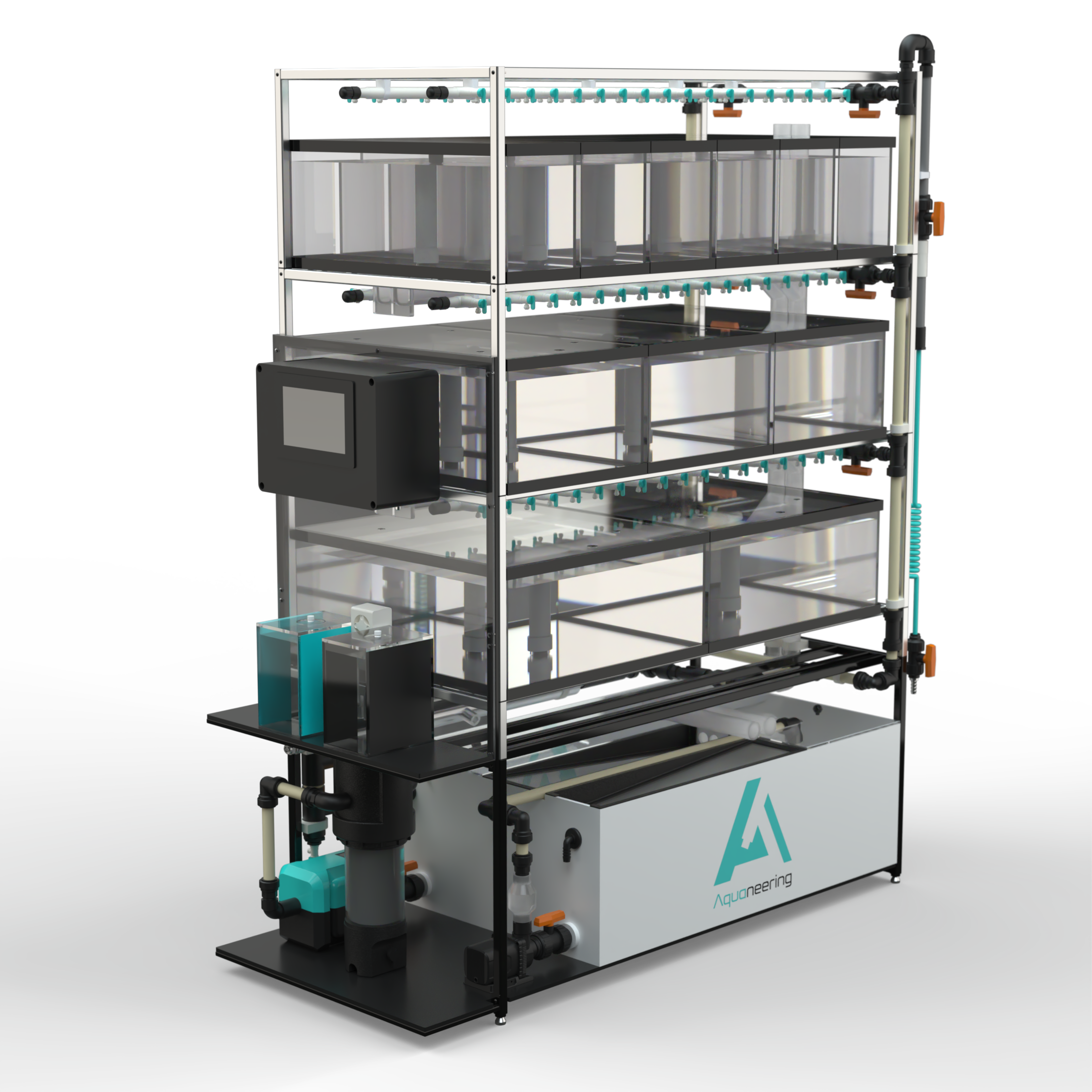
Modular and fully customized solutions. AquaGenZ, AquaFlex, and UltraFlex are built around flexibility — single-sided or double-sided stands, adjustable shelving, multiple tank sizes on the same rack, freshwater or full saltwater configurations, tropical or chilled loops, and layouts engineered around your room's actual columns, ceilings, drains, and doorways. Whether you need one standalone rack for a new PI or a facility-wide central filtration system spanning 3 to 200 racks, the same engineering team scales the design without forcing you into a compromise.
Every model, every salinity, every size. Zebrafish, medaka, killifish, sticklebacks, cichlids, cavefish, Xenopus, axolotls, marine invertebrates, and larger production or physiology species — Aquaneering builds for all of them, including corrosion-proof marine systems with skimming and salinity control, and large-tank configurations for adult and grow-out populations.
24/7 technical support. Real engineers, reachable any hour, who know your system's drawings and history. When a pump fails at 2 a.m., that access is worth more than any spec sheet line item.
The fastest turnaround in the industry. Aquaneering's in-house manufacturing and streamlined process routinely deliver systems faster than competitors — protecting grant timelines, construction schedules, and research momentum.
For lab managers who need dependable water chemistry, minimal maintenance burden, genuine design flexibility, and a partner who answers the phone, Aquaneering is the clear choice — from a single standalone rack to an entire facility.